The Story Behind This Image
Half in Shadow, Fully Back
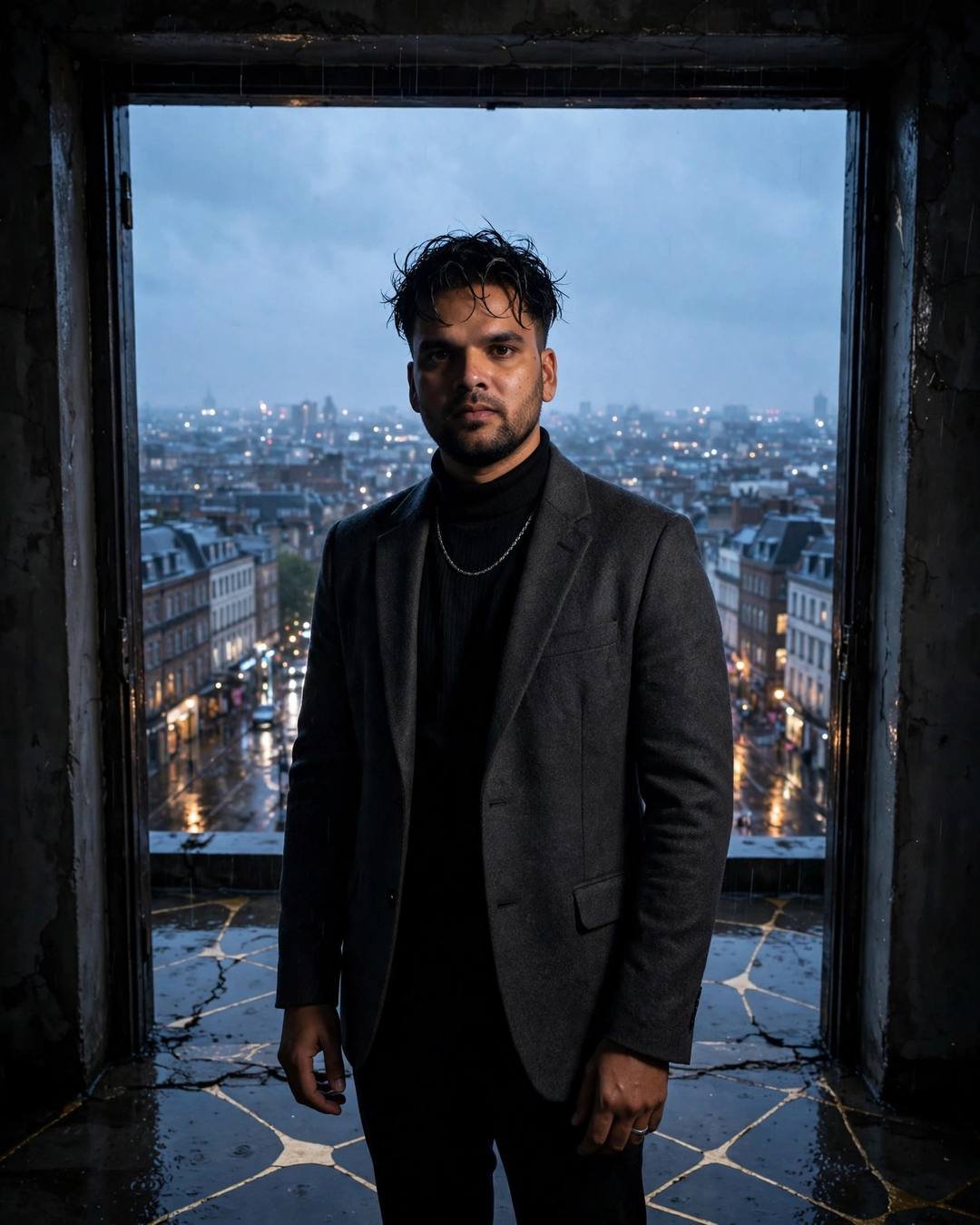
The doorway frames him like a before-and-after photograph. Behind: a dark interior, peeling paint, the honest wreckage of whatever came before. Ahead: a rooftop terrace over a sleeping city, streetlights glittering on post-rain streets, the whole skyline waiting. He stands exactly on the threshold — charcoal blazer, black turtleneck, towel-dried tousled hair — one half of him in shadow, the other lit by the blue hour.
This is the visual thesis of the entire "Broken but Strong" series: the crack is the point. Across the wet terrace floor, fractures run through the stone — and through every fracture, a line of gold. The Japanese art of kintsugi, rendered as architecture: not hiding the break, but illuminating it. He doesn't flinch from the camera. His eyes are calm and steady, the eyes of someone who has stopped apologizing for surviving.
The Rebuild Is the Look
The composition is a study in contrast. The doorway's dark frame holds him like a portrait of an era ending; the city beyond him spreads wide, every light a small kept promise. Blue-hour light does the heavy lifting — cool, clean, unromantic — while the gold seams in the floor do the emotional work, catching what little light there is and refusing to let the ground stay dark.
He wears the blazer like armor and the turtleneck like a decision. Nothing about him is trying to look healed. Everything about him says: healing is a direction, not a destination, and he is walking in it.
- Pose: Standing in a doorway, half in shadow, gaze steady into the lens
- Photography: Vertical 4:5 cinematic portrait, blue-hour backlight with deep interior shadow
- Mood: Cracks filled with gold — hopeful, grounded, unbreakable